
Teaching Fact and Opinion: Easy Popcorn Activity + Free Printable
Teaching fact and opinion is one of the most useful reading skills you can give your kids, and it doesn’t have to be complicated. A fact is something that can be proven true or false, while an opinion is what someone thinks or feels. With kids hearing claims all day long from YouTube, friends, and sometimes even us, they need a way to stop and ask, “Can this be proven, or is it just what someone thinks?”
In this lesson, I’ll walk you through kid-friendly ways to explain the difference, share my favorite mentor text books, and show you a fun popcorn activity that makes it stick for elementary students (grades 2-5). There’s even a free printable to make it easy to teach today.
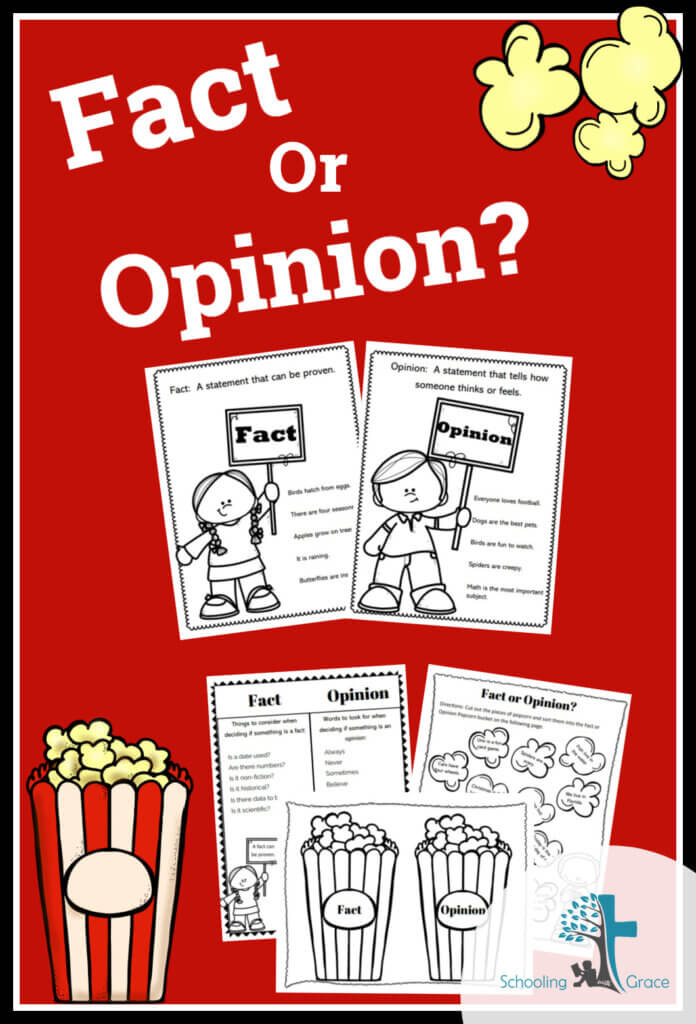
What Is the Difference Between Fact and Opinion?
Here’s the simplest way to explain it to kids:
| Fact | Opinion |
|---|---|
| Can be proven True or False | Is what someone thinks, feels, or believes |
| Can be checked with a source, a measurement, or an observation | Can’t be proven right or wrong |
| Example: Popcorn grows from a seed. | Example: Popcorn is best with butter. |
| Example: Popcorn is made from corn. | Example: Popcorn is the best snack ever. |
A quick question your students can ask themselves is: “Could I prove this with a book, a measurement, or my own eyes?” If yes, it’s a fact. If it depends on who you ask, it’s an opinion.
How do we teach students to recognize opinions?
Opinions often come with clues. Show your kids these three clues, but remind them that clues are hints, not rules. They still need to ask whether the statement can be proven.
1. Feeling words
Opinions often tell us how someone feels about something. If a sentence makes you feel happy, angry, or sad, or if it uses words like love, hate, wonderful, awful, or boring, it’s likely an opinion.
2. Judging words
Words that judge or rate something are big opinion clues. Think of words like best, worst, ugly, beautiful, silly, scary, tastiest, and funniest. (Careful: comparing words can show up in facts too, like “A cheetah runs faster than a lion.” That can be measured, so it’s a fact.)
3. Extreme words
Words like always, never, everyone, no one, nobody, and all often show up in opinions, like “Everyone loves pizza.” These are a great chance to ask, “Is that really true for everyone?”
How do we teach students to recognize facts?
Facts are statements that can be checked or proven. Here are some ways to check:
- Look it up: Can I find it in a trustworthy book or website?
- Measure it: Can I use a ruler, scale, clock, or thermometer?
- Observe it: Can I see or test it myself?
- Check the record: Is it a historical event with a date that can be confirmed?
Notice that numbers and dates can be part of a fact, but they don’t automatically make a statement a fact. “Summer is the best 3 months of the year” has a number in it, but it’s still an opinion!
As an Amazon Associate, we earn from qualifying purchases. This site contains affiliate links see my disclosure here:
Fact and Opinion Examples For Kids
Use these sentences for a quick warm-up, a whiteboard sort, or a game of “stand up for fact, sit down for opinion.”
Grades K-2
- Dogs have four legs. (Fact)
- Dogs are the best pets. (Opinion)
- The sun rises in the morning. (Fact)
- Rainy days are boring. (Opinion)
- Apples grow on trees. (Fact)
- Broccoli tastes yucky. (Opinion)
Grades 3-5
- The Pacific Ocean is the largest ocean on Earth. (Fact)
- Swimming in the ocean is more fun than swimming in a pool. (Opinion)
- George Washington was the first president of the United States. (Fact)
- Learning about history is the most interesting subject. (Opinion)
- A spider has eight legs. (Fact)
- Spiders are creepy. (Opinion)
- Water boils at 212 degrees Fahrenheit at sea level. (Fact)
- Winter is the worst season. (Opinion)
Grades 6-8
- Everyone should learn to play an instrument. (Opinion)
- The human body has 206 bones in adulthood. (Fact)
- Video games are a waste of time. (Opinion)
- The Constitution was signed in 1787. (Fact)
Tricky Cases: When Fact and Opinion Get Mixed Up
Once your kids have the basics, challenge them with statements that are a little harder to sort.
Mixed statements. Some sentences have both a fact and an opinion in them. Have your students underline each part.
“Pizza is the best food because it’s made with cheese.”
The part about being made with cheese is a fact. The part about being the best food is an opinion.
Facts that are false. A fact is something that can be proven, which means it can also be proven wrong. “Popcorn grows on trees” is still a fact-type statement because we can check it, but it’s false. Teach kids that facts need to be verified, not just believed.
Opinions that sound like facts. Someone might say, “Everyone knows math is hard.” It sounds confident, but it can’t be proven. Ask your kids: “Who is everyone? Who decided that?”
Opinions backed by facts. An opinion can be supported with facts (“I think this is the best book because it won an award and has been read by millions of kids”). This helps older students see that opinions can be strong or weak depending on the evidence behind them.
Books that help teach Fact and Opinion
Having a mentor text to explain a tricky concept is always helpful. These books give you a fun jumping-off point for discussion.
- Facts vs. Opinions vs. Robots by Michael Rex: As you are reading the text, have students call out when they hear a fact or when they hear an opinion.
- Dog vs. Cat by Chris Gall: Students have the opportunity to hear the competing opinions and it allows for great discussion between the students.
- Hey, Little Ant by Phillip and Hannah Hoose: This one shows how two characters can look at the same situation and have completely different opinions, and it leaves the ending open so kids can share their own.
- Which Would You Rather Be? by William Steig: Students will have a blast discussing the “would you rather” ideas.


Related Post: Fact and Opinion Activity
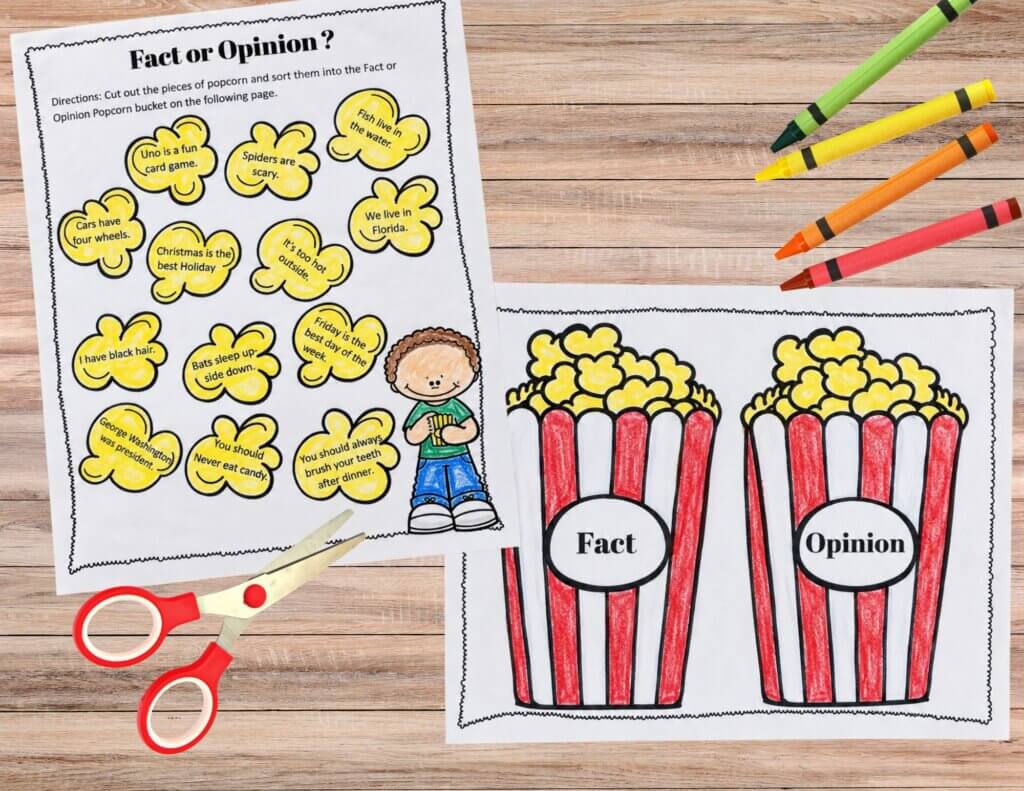
Fact and Opinion Activity: The Popcorn Party
Everyone loves a party, and who doesn’t love popcorn? This hands-on activity gets kids talking and makes the difference between fact and opinion easy to remember.
Grade level: 2-5 (easy to simplify for younger kids) Time needed: 20 to 30 minutes Group size: Works for one child, a family, or a whole co-op class
Materials
A whiteboard or chart paper with two columns: Fact and Opinion
Popcorn (a large bag, or popped at home)
A few popcorn toppings, such as cheddar cheese powder, ranch seasoning, cinnamon sugar, or caramel
Small cups, bowls, or popcorn boxes


Make it Easier or Harder
- Younger learners: Stick to simple, concrete statements and use thumbs up for fact and thumbs down for opinion.
- Older learners: Have them write their own mixed statements and trade with a partner to sort out the fact and opinion parts.
Grab the Free Fact and Opinion Printable Below

Frequently Asked Questions:
What is the difference between fact and opinion?
A fact is a statement that can be proven true or false, such as “A spider has eight legs.” An opinion is what someone thinks or feels, such as “Spiders are creepy.” Opinions can’t be proven right or wrong.
What grade level do you teach fact and opinion?
Kids can begin learning the basics in kindergarten and first grade with simple examples, and it’s commonly taught in grades 2 through 5. Older students can go deeper by sorting mixed statements and evaluating sources.
How do you teach fact and opinion to kids?
Start with a clear definition, give lots of examples, and use hands-on activities like the popcorn party. Then practice with sorting sentences, reading mentor texts, and completing a printable.
Can a statement be both a fact and an opinion?
A single claim is one or the other, but a sentence can contain both. “Pizza is the best food because it has cheese” has a fact (it has cheese) and an opinion (it’s the best food).

Angela is the Homeschool Encourager for the Overwhelmed & Under-Caffeinated and the Chaos-to-Confidence Specialist behind Schooling with Grace. With a no-fluff approach, a dash of humor, and a whole lot of heart, she helps homeschool moms cut through the chaos, ditch unrealistic expectations, and teach with confidence.