
Types of Sentences Game
We have all been around a group of young children, whether it’s at school, at the library or in a Sunday School classroom, where the teacher asks, “Are there any questions?” And 4 hands go up wanting to tell them all about their weekend or how their dog had puppies this weekend. Learning the difference between a statement and a question is a learned skill that has to be practiced. This cute types of sentences game will get the ball rolling in the right direction and is perfect for some Easter fun!

4 Types of Sentences
If you have never taught the different types of sentences, begin by introducing each one. You may want to do this by playing a game, you could start with a game like this one- Types of Sentences Game.
Declarative Sentences: Make statements or share information.
Examples: The children painted Easter eggs in vibrant colors
Interrogative Sentences: Interrogative sentences ask questions.
Examples: Have you ever participated in an Easter egg hunt?
Imperative Sentences: Imperative sentences give commands or make requests.
Examples: Join us for the Easter Sunday service.
Exclamatory Sentences: Exclamatory sentences express strong emotions or excitement.
Examples: What a beautiful Easter morning!
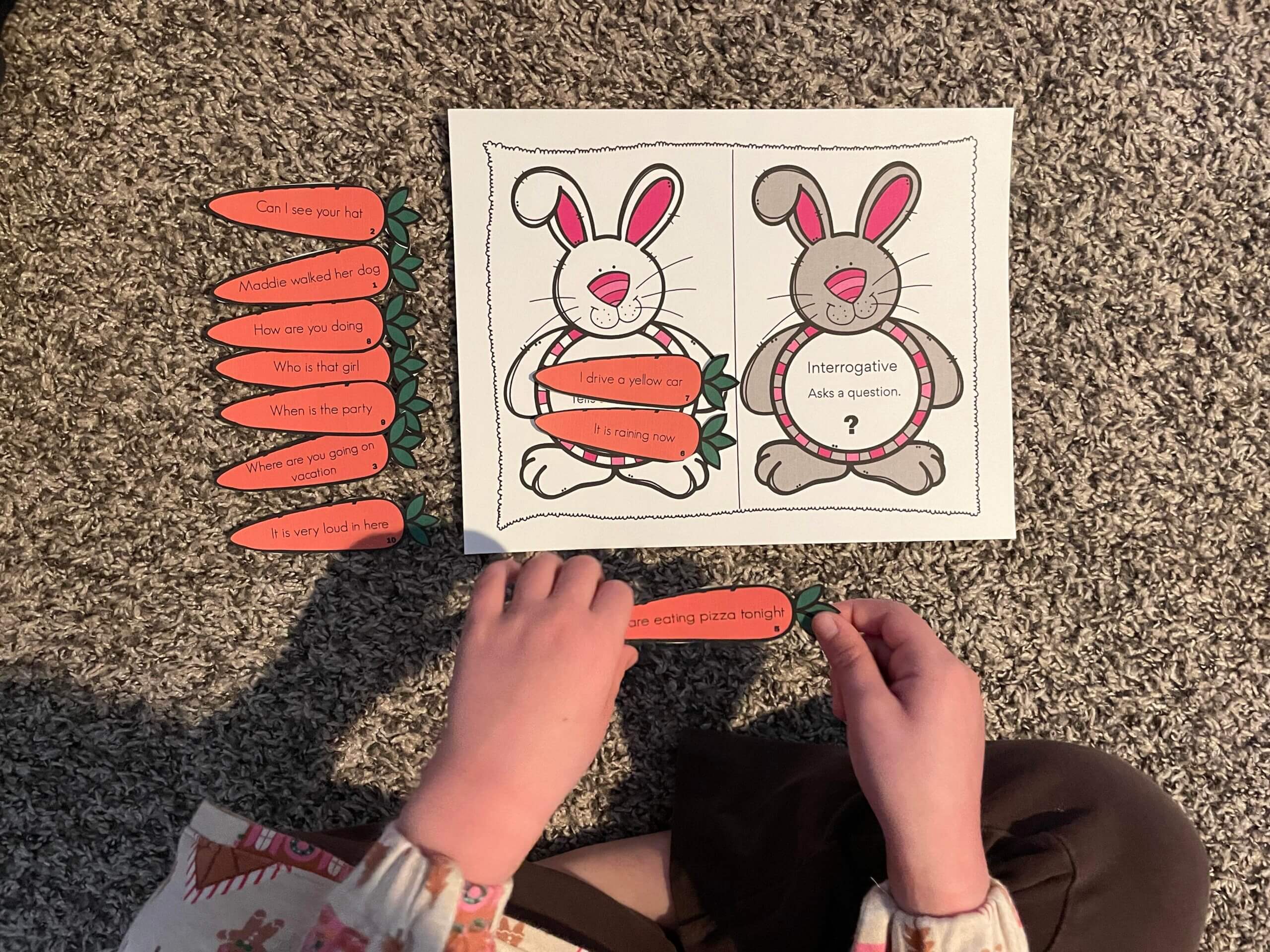
Hop into Sentences Printable:

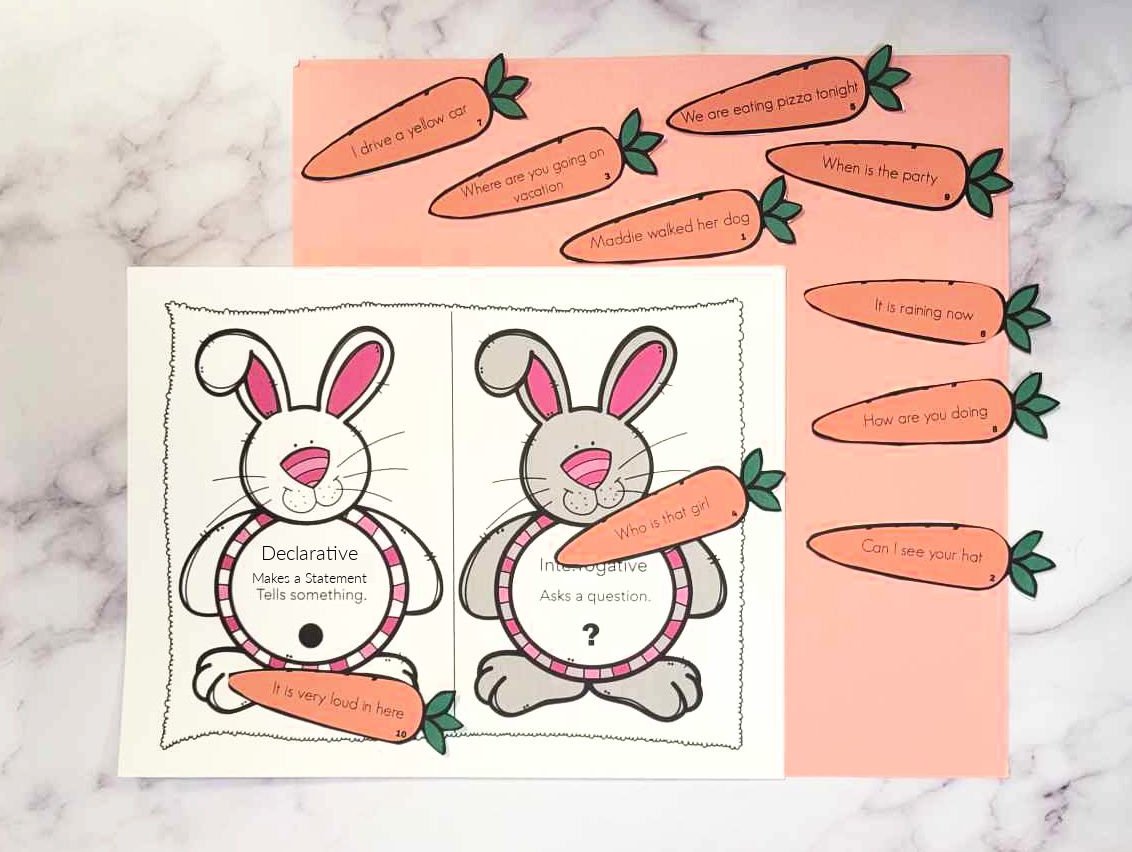
The printable comprises two separate bunnies for sorting sentences – one for interrogative sentences and the other for declarative sentences. Students are provided with a mix of sentences via carrots and are tasked with categorizing each into the correct section. This hands-on approach fosters active learning, allowing students to internalize the concepts through practical application. Students can self-check the answers by comparing the numbers on the carrots to the answer sheet.

Related Post: Identifying the 4 Types of Sentences and Game
Easter Extension Activities for Types of Sentences:
- Create Your Sentences: Encourage students to create their declarative and interrogative sentences. Encourage them to create sentences based on Easter traditions. Provide them with a list of Easter-related words—such as “bunny,” “basket,” “resurrection,” and “lilies”—and ask them to form different types of sentences using these words.
- Sentence Transformation: Provide students with a set of declarative sentences and challenge them to transform each into an interrogative sentence and vice versa. This activity hones their sentence construction skills.
- Sentence Puzzles: Develop sentence puzzles by separating declarative and interrogative sentences into fragments. Students must then rearrange the pieces to form complete, meaningful sentences.
- Real-life Application: Have students find examples of declarative and interrogative sentences in real-world
- Incorporate Easter Games: Introduce games that combine learning sentence structures with Easter fun. For example, an Easter egg hunt where each egg contains a word or phrase, and students must collect eggs to construct various types of sentences.
- Highlight Easter Traditions: Share brief insights into Easter customs from around the world and encourage students to write sentences about them. This not only teaches sentence structure but also broadens cultural understanding.
Grab this Printable Game below.
Resources for Teaching Types of Sentences
Don’t stop the learning with just these printables, these games will help extend the lesson while helping students to solidify their understanding of the types of sentences.
Learning Advantage 6006 Super Sentence Game, Grade: 2 to 4, 9Super Duper Publications | Sentence Building Fun Deck | Speech Therapy Flash Cards for Grammar | Educational Learning Materials for Children
LEARNING ADVANTAGE-6002 Build-A-Sentence – Learning Games for Kids – Sentence Building and Literacy Game – Homeschool Supplies
Learning Resources Skill Builders! Sentence Puzzles – 112 Pieces, Educational Puzzles for Kids, Kindergartner Learning Games, Reading Games for Kids



Angela is the Homeschool Encourager for the Overwhelmed & Under-Caffeinated and the Chaos-to-Confidence Specialist behind Schooling with Grace. With a no-fluff approach, a dash of humor, and a whole lot of heart, she helps homeschool moms cut through the chaos, ditch unrealistic expectations, and teach with confidence.